Someone three miles from you opens ChatGPT tonight and types "best electrician near me." Or they ask Google the same thing and an AI answer appears above the map. Either way, they get three names, each with a sentence or two about why. Your business is in that list or it isn't.
How did it pick those three, and what would it take to be one of them?
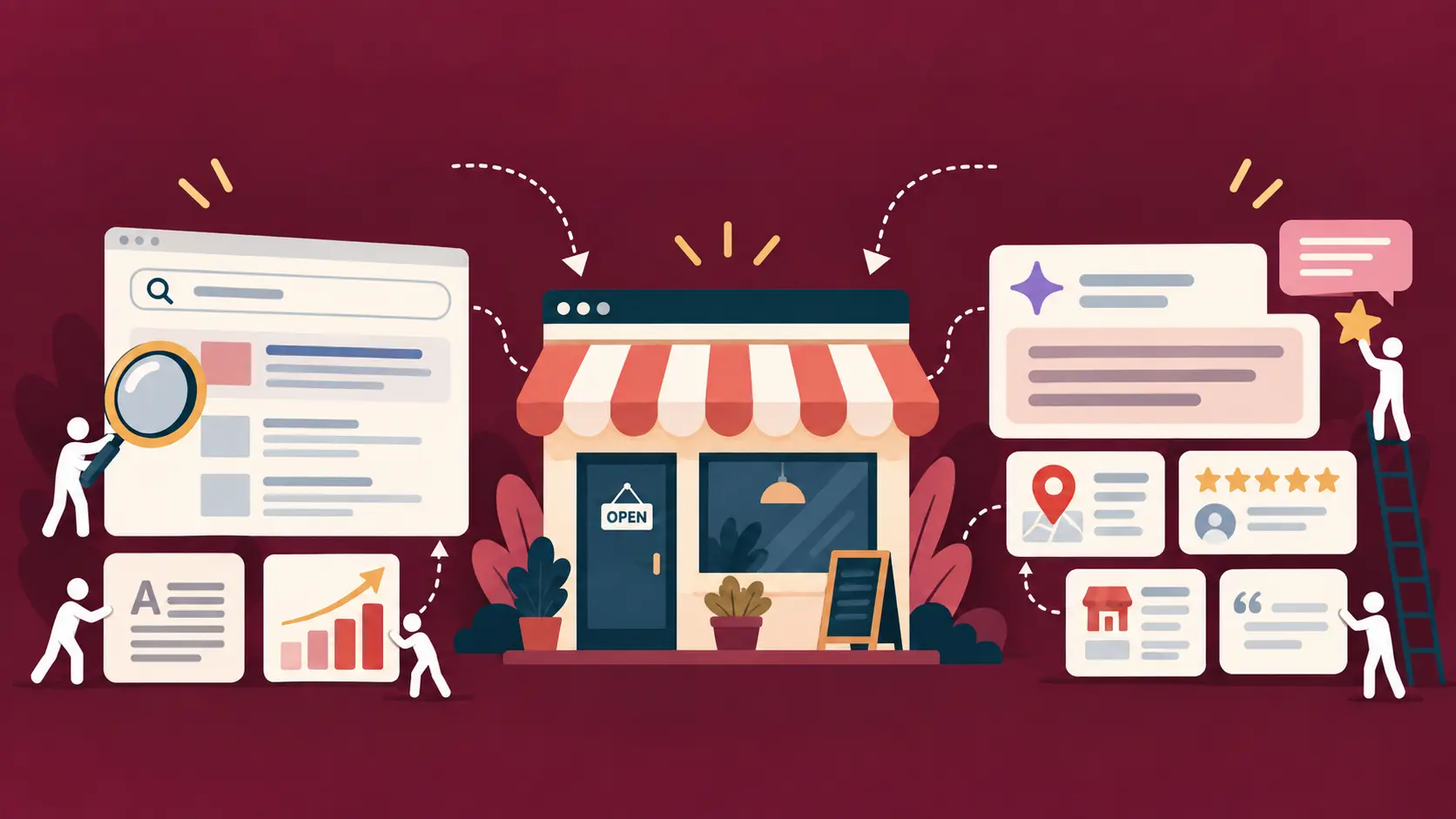
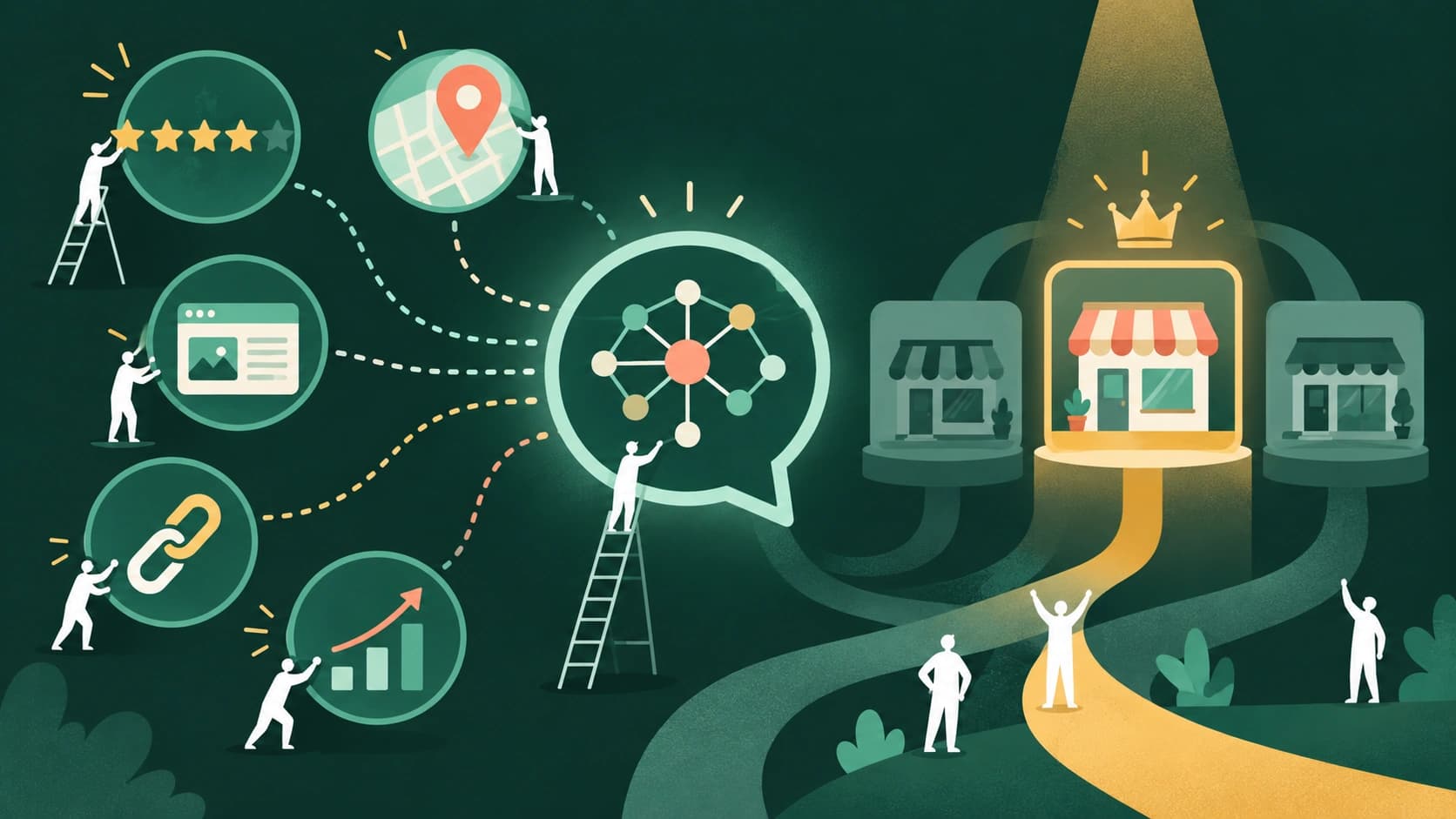
The AI didn't rank you, it looked you up. It ran a few searches, read what Google, the business directories, and your own website say about you, and recommended the businesses those sources agreed were real, nearby, relevant, and well reviewed. Once you see it that way, the rest falls into place.
AI looks you up instead of ranking you
Classic Google results are a list built in advance. Google crawls the web, scores every page, and stores an ordering. When you search, you get the list it already made.
An AI recommendation is assembled on the spot. Think of a new employee you've asked to find a good electrician. They search Google, skim the reviews, open a couple of websites, and pick the one that checks out. The AI does the same thing in about two seconds, and it checks more sources than a person would bother with.
The mechanics vary by platform, but the shape is the same:
- It runs several searches behind the scenes. Google calls this "query fan-out": multiple related searches across subtopics and data sources, issued while the answer is being written.
- It pulls from partner data. Google uses Business Profile and Maps. ChatGPT and Perplexity pull from business directories, with Yelp, TripAdvisor, the Better Business Bureau, and Angi showing up most often.
- It uses the searcher's rough location. OpenAI says ChatGPT estimates a general location from the IP address and may pass it to providers of nearby business listings.
- It reads what it finds and writes a summary.
There is no approved list of businesses, and there is nowhere to apply. When Yelp announced its licensing deal with OpenAI in July 2026, Yelp's CEO told Axios that "if you want to answer local queries, you really need Yelp." The same is true of every directory the AI reads. The model doesn't know your business. It knows what it can find about your business.
That leads to the uncomfortable part. Insites analyzed 10,000 US businesses across ChatGPT and Perplexity in 2026 and found AI could identify 93% of them. Of the businesses it knew, only 55% had accurate details attached, and 41% still weren't recommended for open prompts like "best plumber near me." Being known to the AI and being recommended by it turn out to be different things, and closing the gap between them is what the rest of this article is about.
Where the AI actually gets its information about you
This part usually gets waved away as "your online presence," but it's more specific than that. In August 2026, BrightLocal ran 60,970 checks across 1,355 business locations and logged 1.9 million citations from Google AI Overviews, Google AI Mode, and ChatGPT. Here's where the answers came from.
Google's AI features lean hardest on Google Business Profile, which accounted for 28.6% of all citations in the study. Yelp came second at 9.5%, then Facebook at 2.2%, TripAdvisor at 1.8%, and OpenTable at 1.2%, with MapQuest, the Better Business Bureau, and Angi close behind. For service businesses specifically, Google Business Profile's share rose to 45%, and the BBB, Angi, Houzz, Thumbtack, and HomeAdvisor all appeared regularly. In total, BrightLocal counted 415 different directories being used as sources.
ChatGPT works differently, and it reads directories more than anything else. Yelp appeared as a source in roughly 80% of its local answers, with TripAdvisor, OpenTable, the Better Business Bureau, Angi, Trustpilot, Yellow Pages, and Apple Maps all showing up regularly behind it, while Google Business Profile barely registered. The July 2026 Yelp deal made one of those pipelines formal, but the pattern was already there.
Your own website is not skipped. Insites found the business's own site was cited in 72% of AI answers about it, and BrightLocal found that around 93% of the unique domains cited in its study were individual business websites. The big platforms take the top spots, but the AI reads small business sites at enormous scale.
Then there's everything else, like a local news story, a chamber of commerce page, a neighborhood blog, or a Reddit thread. Reddit alone appeared in the sources for nearly 89% of the businesses in BrightLocal's data, and Whitespark's study of AI Overviews found that for cost questions about Houston plumbers, about 60% of citations went to third-party sites rather than to the businesses themselves.
Try a ten-minute exercise. Open your Google Business Profile, your website, your Facebook page, and your listing on whichever directory your industry uses most, and read them as if you were a stranger. Do they say the same thing, with the same hours, phone number, and services? Would you hire this business based only on those tabs? Whatever you find is what the AI finds.
What actually correlates with being recommended
Nobody outside the platforms knows the exact logic. What exists is correlational research that compares businesses AI recommends against businesses it ignores. Insites' 10,000-business study is the most detailed so far, and while it's one vendor's analysis rather than a published algorithm, the differences it found are large enough to act on.
Review volume was the strongest signal by a wide margin. Businesses AI recommended averaged 133 Google reviews, while businesses it ignored averaged 11, a 12x gap.
Showing up in Google's local pack came next. Businesses in the map results were recommended 3.5 times more often, even on ChatGPT and Perplexity, which don't use Google directly. The likely reason: what gets you into the map pack (a complete profile, reviews, proximity, relevance) is what every other source rewards too.
Directory listings appeared in 35 to 39% of answers, so they help without being the whole story. Accuracy worked as a filter. With only 55% of known businesses carrying correct details, an old phone number or wrong hours is a plausible reason to be left out of a summary that has to sound confident.
The things that didn't move the needle
This is the part worth screenshotting. Insites found no meaningful link between AI recommendations and Core Web Vitals or page speed (pass rates were 1.9% versus 1.1%, near identical), H1 heading structure, or Open Graph tags. Schema markup barely registered. llms.txt files gave what the report calls a marginal lift.
Google says the same thing about its own AI features. Its documentation states there are no additional requirements to appear in AI Overviews or AI Mode, no special schema.org markup to add, and no new machine-readable files to create.
Be careful reading that as "technical SEO doesn't matter." Google still requires a page to be indexed and eligible for a normal search snippet before it can appear in any AI feature, so a site that blocks crawlers or won't load is out. The point is narrower: once the basics work, extra technical polish isn't what moves AI recommendations.
Reviews, accurate listings, and being findable across several sources are. So if someone quotes you a monthly fee for "AI optimization," ask which of the items in the checklist below they'll actually do. The answer is usually the same local SEO work with a new name, and GEO vs. SEO: what really changes for small business is the longer version of why.
Your reviews are already being summarized
One more finding reframes the review question. BrightLocal's 2026 consumer survey found 82% of consumers read AI-generated review summaries, and 59% treat the summary as a starting point before checking full reviews. So the AI is condensing your reviews whether you asked it to or not, and what it writes depends on the material.
A recent review that says "they replaced our water heater the same day and walked us through the pricing" gives the summary something to say. Forty reviews that say "great service" from 2021 give it nothing. The same survey found 74% of consumers only weigh reviews from the last three months.
How to be the one it picks
Everything above points to the same short list. Here it is in the order the evidence supports, written for an owner who has a few hours a month rather than a marketing team.
Make your Google Business Profile complete and current
Fill in every field, including categories, services, hours, service area, description, photos, and attributes. It's the single most-cited source in Google's AI and the anchor other sources cross-reference. If you've never set one up properly, this guide to getting your business on page one of Google walks through creating and verifying a profile.
Claim your listings on the directories the AI actually reads
ChatGPT and Perplexity build their local answers from directories, so an unclaimed or half-empty listing is a hole in the answer. Start with the general ones that appeared across every industry in BrightLocal's data: Yelp, Facebook, the Better Business Bureau, Apple Maps, and MapQuest.
Then add the two or three your customers already use, whether that's Angi or Houzz for trades, Avvo for lawyers, Healthgrades for medical, or TripAdvisor and OpenTable for restaurants. On each one, add photos, services, hours, and a description that match your Google profile.
Get reviews steadily rather than in bursts
The 133 versus 11 gap is the headline number in this article, and it favors habits over campaigns. Ask every happy customer, and tie the request to a moment that already happens, like the day the invoice is paid, so it runs without you remembering.
Mention that it helps if they say what you worked on, because a review that names the service and the outcome is the one that gets quoted. Reply to reviews too, including the bad ones, since replies get read as well. And don't buy or fake reviews: it breaks every platform's rules, and bursty patterns are easy to spot in a summary. For a repeatable system, see how to get Google reviews in eight steps.
Make your website say plainly what you do and where and for how much
Give each core service its own page. State your service area by town or neighborhood, and publish price ranges or starting prices if you can. Put a direct two or three sentence answer at the top of each page, ahead of the story about how you got started.
A dog groomer's page that opens with "Mobile dog grooming in Raleigh, from $85 for small breeds, we come to your driveway" is quotable. One that opens with "Welcome to our family-owned business" is not. If you're starting from scratch, Durable's AI website builder asks three questions about your business and generates service pages you can then fill with these specifics.
Add a real FAQ page
Write down the ten questions customers ask you on the phone and answer them the way you'd say them out loud. Do you charge for estimates? Do you work weekends? Are you licensed for gas lines? Plain, self-contained passages like these are what AI systems lift.
Make every listing agree
Use the same name, address, phone, hours, and website everywhere you're listed. With only 55% of known businesses carrying accurate details in the Insites data, a listing that disagrees with the others is a reason to leave you out, so fix the wrong ones before you add new ones. Doing this by hand across ten sites is tedious, which is why Durable's SEO & GEO tools keep your Google Business Profile in sync with your site and get you listed on the directories that matter for your industry.
Get mentioned somewhere that isn't yours
Aim for a mention in a local news story, a chamber of commerce listing, or a sponsorship page for the Little League team. Try answering questions in your neighborhood Facebook group or a local subreddit when you actually know the answer. These are the unstructured mentions that confirm you exist and that people trust you, and a handful is enough.
Don't block the crawlers
Check that your site's robots.txt file isn't blocking OAI-SearchBot (what ChatGPT uses for search), PerplexityBot, or Googlebot. OpenAI says allowing OAI-SearchBot is what makes a site eligible to appear in ChatGPT search results. Most small business sites are fine by default, but some builders and plugins add blocks without telling you.
Check yourself monthly
Once a month, ask ChatGPT, Google AI Mode, and Perplexity the questions your customers would ask. Note who shows up, what they say about you, and what they get wrong. Then fix the source. If ChatGPT has your old phone number, the fix lives in whichever listing it pulled that number from, and the citations under the answer will usually tell you which one.
Your next steps
Open your Google Business Profile and fill in anything that's blank. Tomorrow, search your business name on Yelp, the Better Business Bureau, Apple Maps, and the two or three directories your industry uses, and claim whatever you find. Before the weekend, ask your last three happy customers for a review, and mention that it helps if they say what you worked on. Then put the monthly AI check on your calendar so it keeps happening.
If you'd rather not manage ten listings by hand, Durable does the tedious part for you. Build your site with the AI website builder, and the built-in SEO & GEO keep your Google Business Profile in sync, find the directories that matter for your industry, and show you where you stand when people ask ChatGPT, Gemini, and Perplexity for a recommendation. Launch for free and see what the AI finds.
Frequently asked questions
How does ChatGPT decide which local businesses to recommend?
It searches in real time using the person's approximate location, pulls business details and reviews from directories like Yelp and the Better Business Bureau and from the open web, then summarizes the businesses those sources agree are relevant, nearby, and well reviewed. There is no fixed list and no way to apply.
Does Google Business Profile affect AI recommendations?
Yes. Google Business Profile was the most-cited source in Google's AI Overviews and AI Mode, at 28.6% of citations in BrightLocal's 2026 study, and businesses in Google's map pack were recommended 3.5 times more often by ChatGPT and Perplexity in Insites' 2026 analysis of 10,000 businesses.
How many reviews do I need to show up in AI search?
There's no threshold. In a 2026 study of 10,000 US businesses, those AI recommended averaged 133 Google reviews and those it ignored averaged 11. Recent, specific reviews matter more than a one-time push, and 74% of consumers only weigh reviews from the last three months.
Can I pay to be recommended by ChatGPT or Google AI?
No. As of September 2026 you can buy labeled ads on Google and, in some cases, in ChatGPT, but there is no paid placement inside the local business recommendations themselves. Anyone promising a guaranteed spot is selling ordinary local SEO work under a new name.
Do I need llms.txt or special code on my website to show up in AI answers?
No. Google's documentation says there are no additional requirements or special markup for AI Overviews and AI Mode, and a 2026 study of 10,000 businesses found llms.txt and schema markup had at most a marginal effect on AI recommendations. Your site needs to be indexable and to say clearly what you do and where.